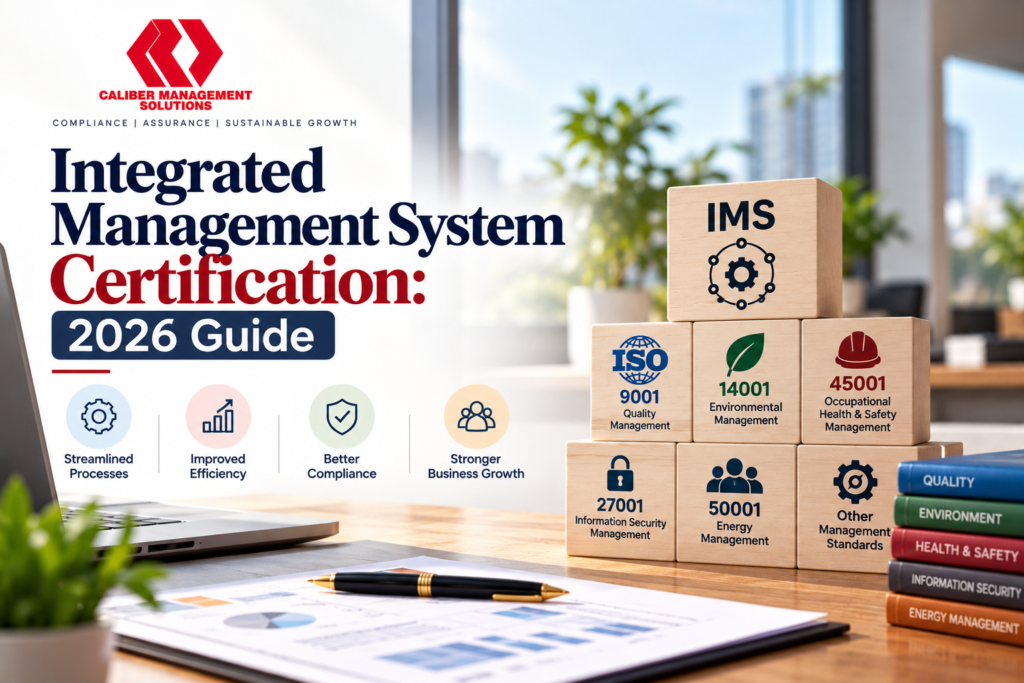
Quick answer: Integrated management system certification combines two or more ISO standards — most commonly ISO 9001 (quality), ISO 14001 (environment) and ISO 45001 (safety) — into a single, unified management system. For businesses that need more than one standard, an IMS saves time, cost and duplicated paperwork, and is certified by an accredited body in one streamlined audit rather than several separate ones.
Many growing businesses eventually need more than one ISO standard — quality for customers, environmental for tenders, safety for their workforce. Managing those as three separate systems is slow and repetitive. An integrated management system solves that. This guide explains integrated management system certification in plain language and why it’s often the smarter route.
What is integrated management system certification?
An Integrated Management System (IMS) combines multiple ISO standards into one coherent framework, so you run a single set of policies, processes and audits instead of several overlapping ones. Integrated management system certification means an accredited body has audited that combined system and confirmed it meets all the standards you’ve chosen. Because modern ISO standards share a common structure (defined by ISO), they fit together naturally — a quality, environmental and safety system can live under one roof.
In simple terms: one system, one set of documents, one audit — covering several standards at once.
Which standards are usually integrated?
The most common combination is the “big three,” each of which we also certify individually:
- ISO 9001 – Quality Management
- ISO 14001 – Environmental Management
- ISO 45001 – Occupational Health & Safety
Businesses can also add others — such as ISO 50001 (energy) or ISO 27001 (information security) — depending on their needs. Not sure which standards apply to you? Our guide on which ISO certification your business needs can help.
Who needs an integrated management system?
An IMS is ideal for organisations that require (or expect to require) more than one standard, including:
- Manufacturers and industrial units needing quality, environmental and safety standards
- Construction and infrastructure firms juggling multiple compliance requirements
- Larger businesses bidding for tenders that demand several certifications
- Any organisation that already holds one ISO standard and plans to add more
If you need two or more standards, integrated certification is almost always more efficient than certifying each separately.
The benefits of an integrated management system
- Saves cost: one combined audit is cheaper than several separate certification audits.
- Saves time: shared documentation and processes cut duplicated effort.
- Less complexity: one system to run and maintain, not three.
- Consistent management: aligned objectives and reviews across quality, environment and safety.
- Stronger for tenders: demonstrates broad, mature compliance in one go.
How to get integrated management system certification
The process mirrors a single-standard certification, just covering more ground: choose your standards, run a combined gap analysis, build one integrated set of documentation and controls, train your team and pass the Stage 1 and Stage 2 audits with an accredited body. An IMS usually takes a little longer than a single standard but far less time than certifying each one individually. Read the full process in our guide on how to get ISO certification in Guwahati.
Ready to combine your standards? Caliber Management Solutions builds and prepares integrated management systems for businesses across Assam — see our ISO certification in Guwahati service.
Key takeaways
- An integrated management system combines multiple ISO standards into one framework.
- The most common mix is ISO 9001, ISO 14001 and ISO 45001.
- Benefits: lower cost, less duplication, simpler management and stronger tenders.
- One combined audit replaces several separate certification audits.
Get integrated management system certification with expert support
If your business needs more than one ISO standard, an IMS is the efficient way forward. At Caliber Management Solutions, we design and prepare integrated management systems tailored to your operations — handling documentation, training, and the combined audit end to end across Assam and the Northeast. Explore our ISO certification in Guwahati service or call +91 87249 39179 for a free consultation.
Frequently asked questions
What is an integrated management system (IMS)? It’s a single management system that combines two or more ISO standards — such as ISO 9001, 14001, and 45001 — into one unified framework of policies, processes and audits.
What is the benefit of integrated management system certification? It saves cost and time by replacing several separate audits and documentation sets with one combined system, while keeping quality, environment and safety aligned.
Which standards can be integrated? Most commonly ISO 9001, ISO 14001 and ISO 45001, with others such as ISO 50001 or ISO 27001 added depending on your needs.
Is an IMS cheaper than separate certifications? Usually yes — one combined audit and shared documentation cost less than certifying each standard separately.
How long does IMS certification take? It takes a little longer than a single standard but far less than certifying each one individually — typically a few months depending on your size and readiness.