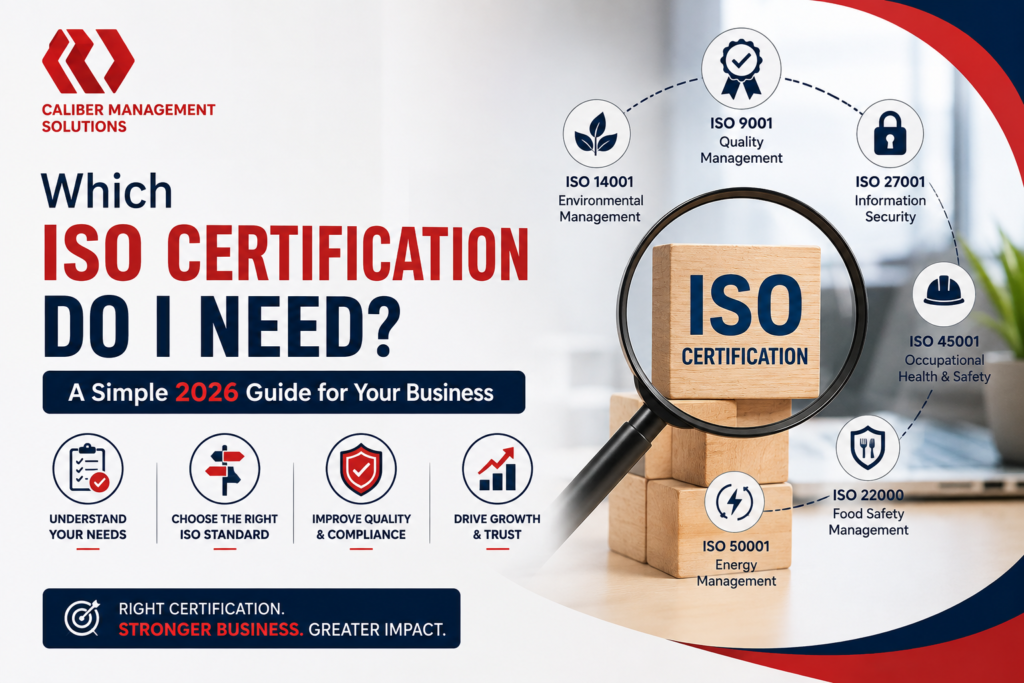
Which ISO Certification Do I Need? A Simple 2026 Guide for Your Business
Quick answer: Which ISO certification do I need? It depends on what you want to prove. ISO 9001 is for overall quality and suits almost any business. Choose ISO 14001 for environmental management, ISO 45001 for workplace safety, ISO 22000 for food safety, ISO 27001 for information security, and ISO 13485 for medical devices. Most businesses start with ISO 9001, then add others as clients or tenders require.
There are dozens of ISO standards, and the names all blur together — 9001, 14001, 27001. If you’ve ever stared at that list wondering which one you actually need, this guide is for you. We’ll break down the main standards in plain language, tell you who each one suits, and help you pick with confidence.
Start with one question: what are you trying to prove?
Every ISO standard exists to prove something specific about how you operate — your quality, your safety, your data security, and so on. So the fastest way to choose is to ask what your customers, tenders, or regulators actually want to see. Once you know that, the right standard is usually obvious.
Here are the main ones.
ISO 9001 — Quality Management (the usual starting point)
Best for: almost any business, in any industry.
ISO 9001 proves you have consistent, well-run processes and a focus on customer satisfaction. It’s by far the most widely held certification, and it’s what most tenders mean when they simply ask for “ISO certification.” If you’re not sure where to start, start here.
ISO 14001 — Environmental Management
Best for: manufacturing, construction, and businesses that want to show environmental responsibility.
ISO 14001 shows you manage your environmental impact responsibly — waste, energy, emissions. It’s increasingly asked for in government and large private contracts.
ISO 45001 — Occupational Health and Safety
Best for: any workplace where safety matters — factories, construction sites, warehouses.
ISO 45001 proves you have a strong system for keeping workers safe and reducing risk. It builds trust with staff, clients, and regulators alike.
ISO 22000 — Food Safety
Best for: food processors, manufacturers, restaurants, caterers, and packagers.
ISO 22000 proves your food is handled safely from start to finish. For Assam’s food and tea businesses, it’s often essential for supplying larger buyers and exporters.
ISO 27001 — Information Security
Best for: IT companies, software firms, BPOs, and anyone handling sensitive data.
ISO 27001 proves you protect information properly. As data security becomes a bigger concern, more clients now require it before they’ll share data with a supplier.
ISO 13485 — Medical Devices
Best for: medical device manufacturers and healthcare suppliers.
ISO 13485 is the quality standard specific to medical devices, and it’s usually mandatory to sell into that market.
ISO 50001 — Energy Management
Best for: energy-intensive businesses looking to cut consumption and cost.
ISO 50001 helps you manage and reduce energy use systematically — useful for manufacturers and large facilities.
How to decide which ISO certification you need
Still unsure which ISO certification you need? Work through these three questions:
- What are your clients or tenders asking for? If a contract names a standard, that decision is made for you.
- What does your industry expect? Food businesses lean to ISO 22000, IT to ISO 27001, manufacturers to ISO 9001 and 14001.
- What’s your goal? General credibility and better processes point to ISO 9001; a specific risk (safety, data, environment) points to the matching standard.
Many businesses need more than one — and certifying them together (an integrated system) is cheaper and simpler than doing each separately.
Key takeaways
- ISO 9001 (quality) suits almost any business and is the usual starting point.
- Match the standard to what you need to prove: environment (14001), safety (45001), food (22000), data (27001), medical devices (13485), energy (50001).
- Let your clients, tenders, and industry guide the choice.
- You can certify multiple standards together to save time and cost.
Not sure? Get free advice
Choosing the wrong standard is an expensive mistake, so it’s worth a quick conversation before you commit. We’ll recommend the right one for your business — free of charge. See our ISO certification in Guwahati page, or call +91 87249 39179. New to the whole process? Start with our guide on how to get ISO certification in Guwahati, or see what it costs in our ISO certification cost guide.
Frequently asked questions
Which ISO certification is best for a small business? ISO 9001 (Quality Management) is the most common and affordable starting point and suits almost any small business.
What is the difference between ISO 9001 and ISO 14001? ISO 9001 is about quality and consistent processes; ISO 14001 is about managing your environmental impact. Many businesses hold both.
Can I get more than one ISO certification? Yes. Businesses often combine standards — like ISO 9001 with ISO 14001 and ISO 45001 — into one integrated system, which is cheaper than certifying each separately.
Which ISO standard is needed for government tenders? It varies by tender, but ISO 9001 is the most commonly requested. Always check the specific tender requirements.
How do I know which ISO standard my business needs? Look at what your clients or tenders ask for and what your industry expects. If you’re unsure, a free consultation with an ISO consultant will point you to the right one.