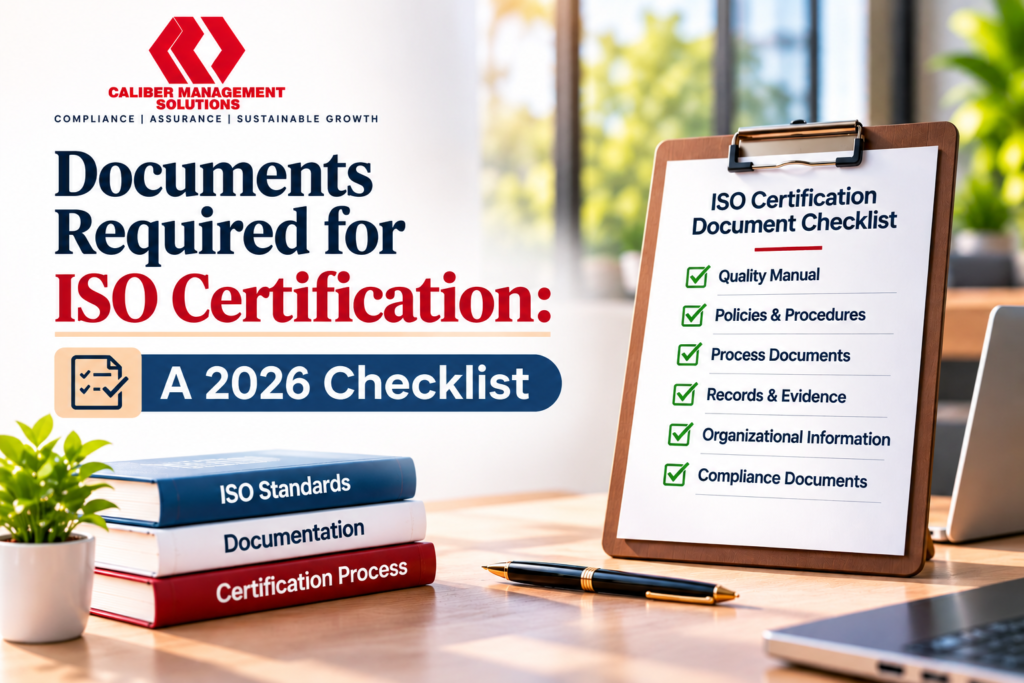
Quick answer: The documents required for ISO certification include your business registration proof, an overview of your products or services, a documented management system (policy, objectives and procedures), process records, risk assessments and internal audit and management review records. The exact list depends on the ISO standard you choose, but the goal is always the same: documentation that reflects how your business actually operates.
One of the first questions every business asks before starting is: “what paperwork will we actually need?” It’s a fair question — and the honest answer is that it’s more manageable than most people fear. This checklist breaks down the documents required for ISO certification in plain language, so you know exactly what to prepare.
What documents are required for ISO certification?
The documents required for ISO certification fall into a few simple groups. International standards (published by the International Organization for Standardization) call this “documented information” — and rather than a mountain of forms, think of it as simply writing down how you already work. A typical set includes:
1. Business and scope information
- Business registration or incorporation proof
- GST registration
- An overview of your products, services and sites
- The scope of certification (what parts of the business are covered)
2. The management system itself
- A policy (for example, a quality or environmental policy)
- Objectives and measurable targets
- Documented procedures for your key processes
- Roles and responsibilities
3. Operational records
- Process controls, registers and forms
- Risk assessments
- Monitoring and measurement records
- Supplier and customer records relevant to the standard
4. Evidence of the system working
- Internal audit records
- Management review records
- Corrective actions and improvement records
The documents should reflect your organisation’s actual operations — not a generic template copied from elsewhere.
Do the documents change by standard?
Yes. While the structure above is common to all standards, the exact documents required for ISO certification vary by the standard you choose:
- ISO 9001 focuses on quality processes and customer satisfaction records.
- ISO 14001 adds environmental aspects, legal registers and impact controls.
- ISO 45001 adds hazard identification, risk assessments and safety records.
- ISO 22000 adds food-safety and HACCP documentation.
Not sure which standard applies to you? Our guide on which ISO certification your business needs explains the options.
You don’t have to prepare them alone
Here’s the reassuring part: you rarely start from a blank page. Most of what the documents required for ISO certification ask for already exists in some form in your business — it just needs organising into the right structure. A good consultant turns your real processes into compliant documentation, so you avoid both under-documenting (gaps the auditor will flag) and over-documenting (paperwork you’ll never use).
How documents fit into the certification process
Documentation is one step in a larger process: understand your requirement, run a gap analysis, prepare the documents, implement the system, run an internal audit and management review, and then pass the certification audit. For the full walkthrough, see our guide on how to get ISO certification in Guwahati.
Key takeaways
- The documents required for ISO certification cover scope, the management system, operational records and evidence it works.
- The exact list depends on the ISO standard you choose.
- Documentation should reflect how your business actually operates.
- You usually don’t start from scratch — most records already exist in some form.
Get help preparing your ISO documentation
Preparing documentation is where many businesses get stuck — but it doesn’t have to slow you down. At Caliber Management Solutions, we prepare all the documents required for ISO certification — audit-ready and tailored to your operations and your chosen standard. Explore our ISO certification in Guwahati service or call +91 87249 39179 for a free consultation and a tailored checklist.
Frequently asked questions
What documents are required for ISO certification? Business registration proof, an overview of your products or services, a documented management system (policy, objectives, procedures), operational records, risk assessments and internal audit and management review records. The exact list depends on the standard.
Are the documents the same for every ISO standard? No. The structure is similar, but each standard adds its own specific documents — for example, environmental registers for ISO 14001 or hazard assessments for ISO 45001.
Do I need to write all the documents myself? No. Most of what’s needed already exists in your business in some form and a consultant can turn your real processes into compliant, audit-ready documentation.
How many documents does ISO certification need? There’s no fixed number — the documentation should match the size and complexity of your business, not a generic template.
Can documentation be digital? Yes. ISO standards accept documented information in digital or paper form, as long as it’s controlled and reflects actual operations.