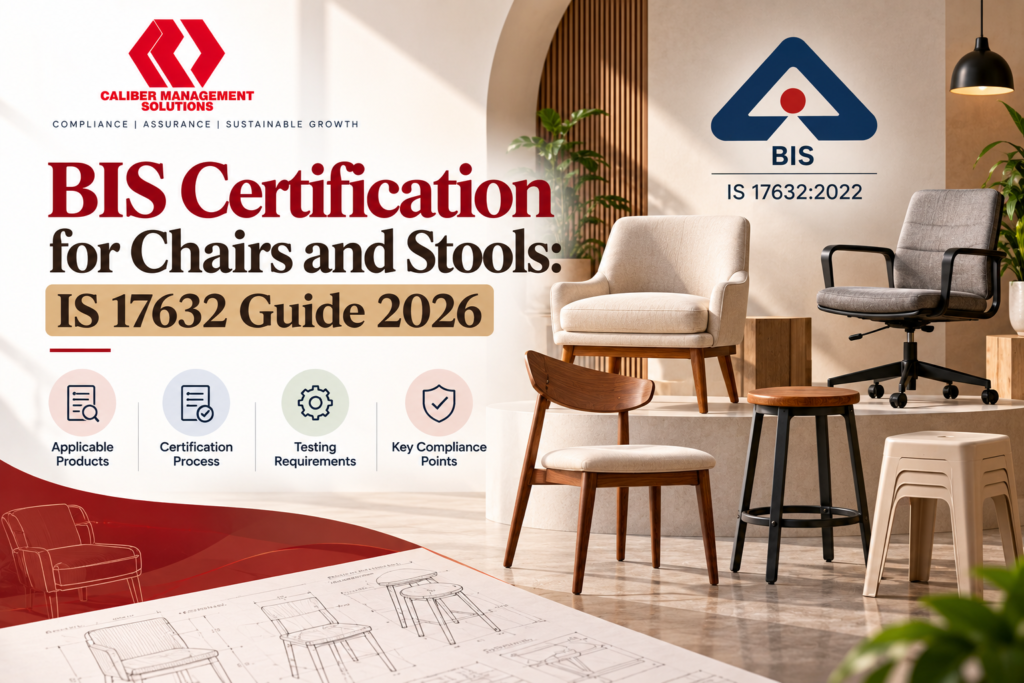
BIS certification for chairs and stools is now mandatory in India under the Furniture QCO. If you manufacture or import general-purpose seating, your products must meet Indian Standard IS 17632:2022 and carry the ISI Mark before they can be legally sold. This guide explains what IS 17632 covers, what BIS tests for, who needs to comply and how to get certified in 2026 without costly delays.
What does IS 17632 cover?
IS 17632:2022 is the Indian Standard for general-purpose chairs and stools — the non-rotating seating used in homes, restaurants, schools and commercial spaces. BIS certification for chairs and stools under this standard applies to:
- Dining chairs and restaurant or cafe chairs
- Plastic, metal and wooden general-purpose chairs
- Bar stools and kitchen stools
- Folding and stackable chairs
- Visitor and banquet seating
If your seating is fixed and general-purpose rather than a rotating work chair, it falls under IS 17632. This is one of the broadest furniture categories, so a large share of seating makers and importers are affected.
IS 17632 vs IS 17631 — which applies?
This is the most common point of confusion. The simple rule: rotating height-adjustable office chairs fall under IS 17631 while fixed general-purpose chairs and stools fall under IS 17632. A swivel task chair is IS 17631. A plastic dining chair or a bar stool is IS 17632. Applying under the wrong standard leads to rejection or repeat testing, so confirm the scope before you file. If your range includes both types, you may need certification under both standards.
Why BIS certification for chairs and stools is mandatory
Under the Furniture (Quality Control) Order, chairs and stools are among the six notified categories. That makes BIS certification for chairs and stools a legal requirement — selling non-certified seating is an offence under the BIS Act, 2016 and can bring fines, product seizure and blocked sales. Certification also builds buyer trust and keeps you eligible for government and institutional tenders including the GeM portal, where ISI-marked products are expected.
What does BIS test under IS 17632?
For BIS certification for chairs and stools, samples are evaluated for:
- Seat and backrest strength under static, impact and fatigue loads
- Leg strength and stability to prevent tipping or collapse
- Durability of joints and frames over repeated use
- Safety of exposed edges and folding mechanisms
These tests confirm the seating can handle everyday use safely across its full lifespan. For high-volume products like plastic chairs, consistent quality across production batches is exactly what the standard is designed to verify.
Who needs BIS certification for chairs and stools?
Anyone who makes, imports or sells general-purpose seating in India:
- Manufacturers apply for an ISI Mark license.
- Importers must sell only certified ISI-marked seating — through a certified foreign manufacturer under FMCS or a certified supplier.
- Plastic-molded furniture makers and hospitality suppliers are squarely covered, since dining chairs and stools are high-volume categories.
Benefits of certifying early
Beyond simply staying legal, early BIS certification for chairs and stools is a commercial advantage. Certified sellers can list on government procurement platforms, supply large institutional buyers and reassure retail customers that their seating is tested to Indian standards. As the QCO deadline approaches, non-certified competitors will be forced off the shelves — so the manufacturers who certify first capture that demand.
How to get BIS certification for chairs and stools
The process follows the standard BIS route:
- Confirm IS 17632 is the correct standard for your product.
- Prepare documentation — business papers, factory layout, machinery list and quality-control procedures.
- Apply on the BIS Manak Online portal and pay the fees.
- Test samples at a BIS-recognized lab against IS 17632.
- Pass the factory inspection.
- Receive your CM&L license and affix the ISI Mark.
For the full journey see our BIS certification process for furniture, confirm whether BIS certification is mandatory for furniture or get end-to-end help via BIS certification for furniture in Guwahati.
Frequently Asked Questions
Is BIS certification for chairs and stools mandatory in India? Yes. General-purpose chairs and stools are covered under IS 17632 and the Furniture QCO and must carry the ISI Mark before being sold.
Do plastic molded chairs need BIS certification? Yes. General-purpose plastic chairs fall under IS 17632 and must carry the ISI Mark once the QCO applies to your enterprise category.
What is the difference between IS 17631 and IS 17632? IS 17631 is for rotating adjustable office chairs while IS 17632 is for fixed general-purpose chairs and stools.
Can one license cover several chair models? Often yes — similar products under the same standard can be grouped, though testing requirements still apply per the standard.
Manufacture or import chairs and stools? Caliber Management Solutions handles BIS certification for chairs and stools under IS 17632 — from documentation and testing to the ISI Mark license — for businesses across Guwahati, Assam and Northeast India. Book a free consultation today.